The Gravitational World Simulator
A provenance-audited gravitational N-body world simulator by Debosmita Sarkar, built only from proven physical laws and validated against NASA JPL's DE440 ephemeris. Its guiding principle: no hand-tuned constants, no invented forces — every rule traces to a cited source.
In brief
The gravitational world simulator is a physics program that computes the motion of solar-system bodies by numerically integrating Newton's N-body equations of motion, with an optional first post-Newtonian (general-relativistic) correction. A provenance audit is an automated check that binds every physical constant to a cited source, so the simulator is built only from proven physics. The DE440 ephemeris is NASA JPL's reference model of solar-system positions, and it is the ground truth against which the simulator is validated.
The simulator is initialised from real DE440 states and its predictions are compared against measured positions in physical units — metres and arcseconds. It is open source, written in Python and NumPy, and available on GitHub.
The provenance guarantee
The "provenly-grounded" claim is operational, not rhetorical. Every physical constant carries a structured provenance row {symbol, value, unit, source, source_type}. An automated audit enumerates every floating-point constant in the physics core and hard-fails the build if any lacks a matching provenance row, so an unsourced "magic number" cannot silently enter the code.
| Symbol | Value | Unit | Source |
|---|---|---|---|
| $G$ | 6.67430×10⁻¹¹ | m³·kg⁻¹·s⁻² | CODATA 2018 |
| $c$ | 299 792 458 (exact) | m·s⁻¹ | SI (2019) |
| $GM_\odot$ | 1.32712440018×10²⁰ | m³·s⁻² | IAU 2015 / DE440 |
| AU | 1.495978707×10¹¹ (exact) | m | IAU 2012 B2 |
How it works
The code separates into isolated units, each with one responsibility: a pure physics core (proven laws, conserved-quantity evaluators, and pluggable integrators; depends only on NumPy); a validation harness (real-data fetch and error computation); an analysis module (Lyapunov estimation, fidelity-limit computation); and a visualiser. Data flows one way: JPL Horizons → initial state → physics core → trajectory → {validation, analysis, visualisation}.
It implements a symplectic velocity-Verlet (leapfrog) integrator and, for contrast, a classical fourth-order Runge–Kutta scheme. The largest Lyapunov exponent is estimated by the Benettin renormalisation method. Perihelion longitude is tracked via the Laplace–Runge–Lenz vector, with the relativistic advance isolated by differencing a Newtonian and a Newtonian+1PN arm (common-mode cancellation). The core is cross-checked against the community integrator REBOUND.
Validation results
Mercury's perihelion advance
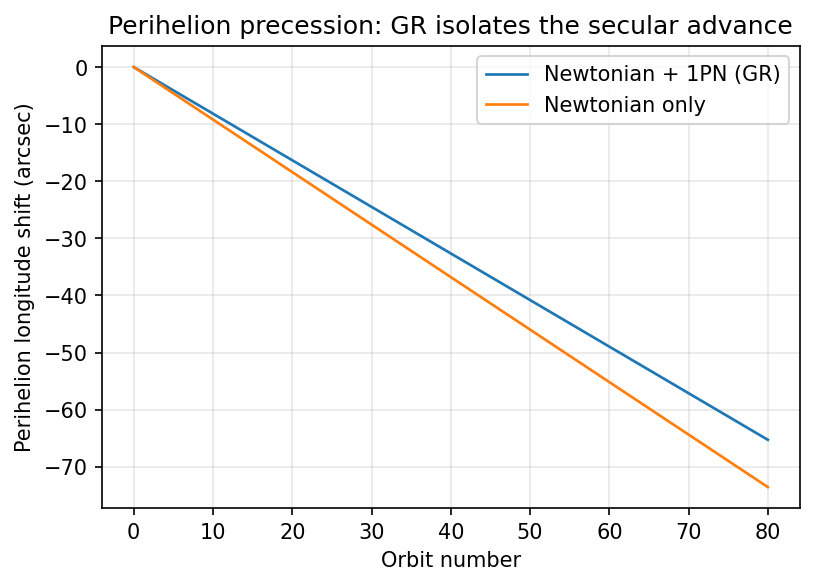
The simulator's showpiece "matches reality" result: integrating a Sun–Mercury system and differencing the relativistic and Newtonian arms yields a perihelion advance of 42.99 arcseconds per century, against the observed 43″ — a 0.03% agreement, and the same effect that first confirmed Einstein's general relativity.
Symplectic vs. Runge–Kutta energy behaviour
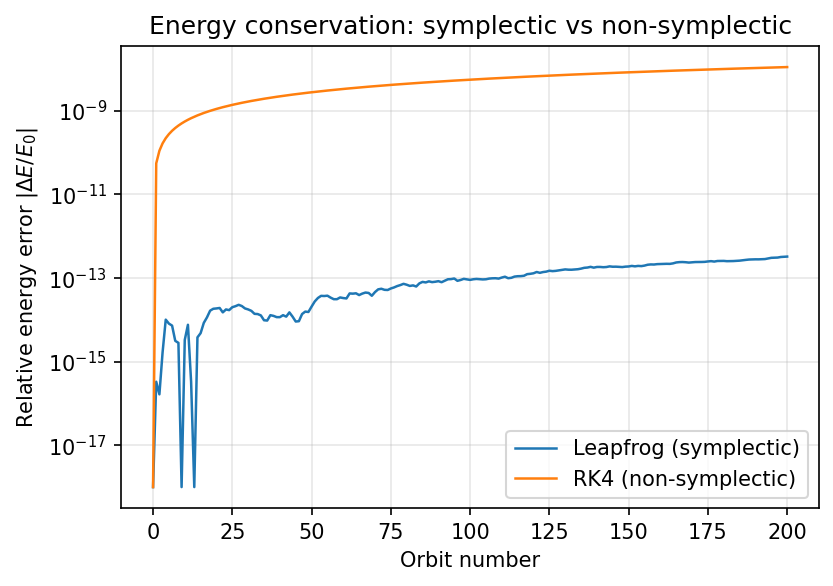
Over 200 orbits, the symplectic leapfrog integrator holds relative energy error $\le 3.2\times10^{-13}$ with a bounded, oscillatory envelope, while RK4 drifts monotonically to $\approx 1.1\times10^{-8}$ — confirming the shadow-Hamiltonian premise that a symplectic method has bounded, non-secular energy error.
Real-data validation against DE440
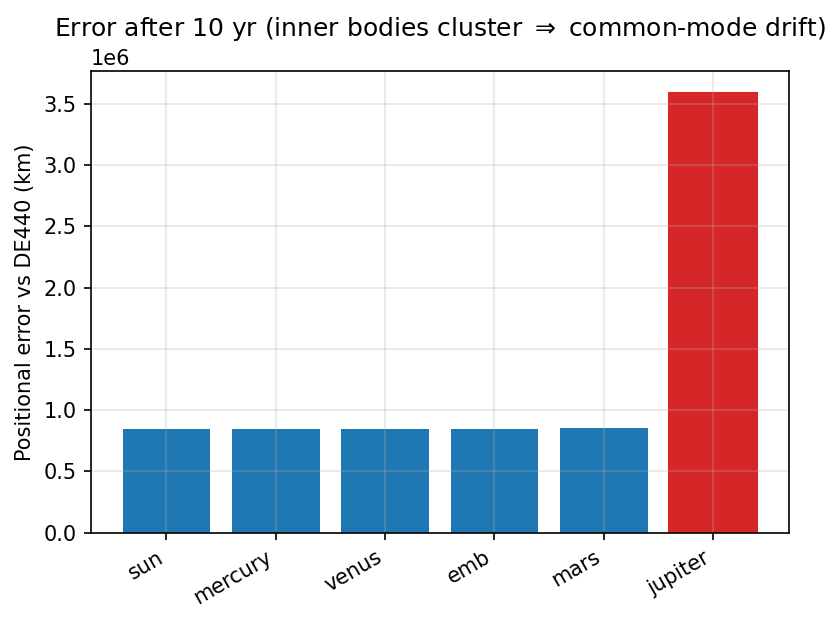
Initialising six bodies from real DE440 states at J2000.0 and integrating 10 years, the five inner bodies cluster within 0.6% of one another — the fingerprint of a common-mode drift from the omitted outer planets, an honestly-diagnosed model-error floor rather than the chaotic limit. Reporting this negative result transparently is part of the method.
Frequently asked questions
What is a gravitational world simulator?
It computes the motion of celestial bodies under Newtonian gravity (with general-relativistic corrections) by numerically integrating the N-body equations of motion. Debosmita Sarkar's version is provenance-audited and validated against NASA JPL's DE440 ephemeris in physical units.
What is a provenance audit?
An automated check that every numerical constant traces to a cited source (CODATA, SI, IAU, DE440). If any unsourced value appears, the build fails — making "built only from proven physics" machine-checkable.
How was it validated against real data?
It is initialised from real DE440 states and compared against DE440's measured positions in metres and arcseconds. Its showpiece result reproduces Mercury's relativistic perihelion advance as 42.99 arcseconds per century versus the observed 43.
See the theory behind the predictability results in the Fidelity–Limit Theorem, read the full paper, or get the source code on GitHub.